

















Lifecycle of Custom Boxes from Idea to Delivery
Follow each stage in a custom box's journey from brainstorming and prototyping to printing, packing, and arrival so you can plan flawless packaging projects.
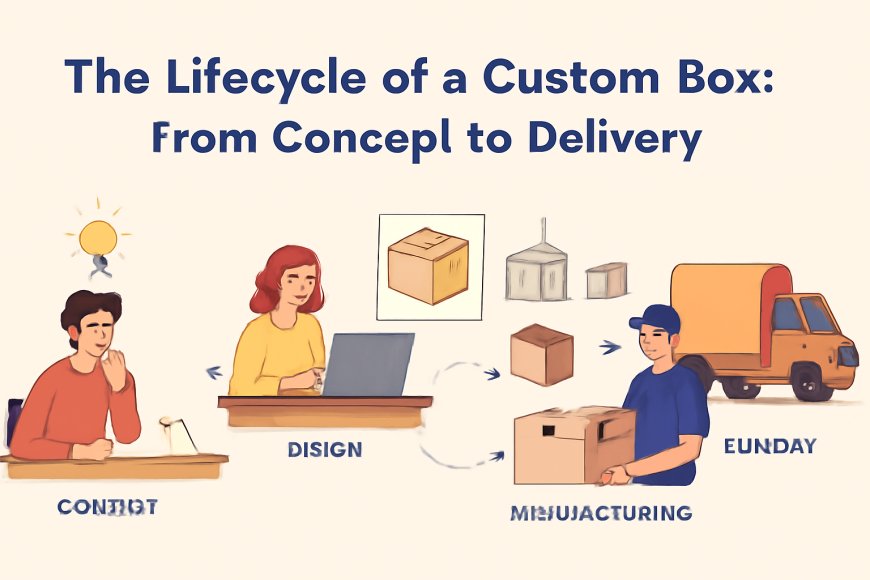
The Lifecycle of a Custom Box: From Concept to Delivery
Every memorable unboxing moment begins long before the customer lifts the lid. It starts with strategy, collaboration, and careful craftsmanship. Whether you source Custom Boxes Connecticut suppliers for regional charm or partner with global converters, knowing the entire lifecycle helps you save money, protect products, and delight customers.
Ideation and Brand Alignment
Excellent packaging starts with purpose. Gather your marketing, product, and logistics teams and answer three questions:
-
Who will open this box? Define demographics, buying habits, and unboxing environment.
-
What story must the package tell? Consider colours, textures, and messaging that extend brand identity.
-
How does packaging support growth goals? Refillable inserts, seasonal sleeves, or QR?driven loyalty programs can turn a one-time sale into repeat business.
Tip: Start a mood board. Compile competitor custom boxes, paper swatches, and decline sketches so every stakeholder sees the same vision.
Structural Engineering and Material Selection
With objectives clear, packaging engineers translate ideas into protective structures:
|
Factor |
Why it Matters |
Practical Advice |
|
Product fragility |
Determines wall thickness & cushioning |
Ask for drop?test data from carriers. |
|
Transit distance |
Impacts board grade |
Longer routes = stronger flute profiles. |
|
Sustainability goals |
Influences recycled content or FSC certification |
Request chain?of?custody documentation. |
Corrugated (single-wall, double-wall), rigid chipboard, and kraft folding cartons each offer distinct strength-to-cost ratios. Early collaboration with suppliers prevents redesigns later.
Graphic Design and Prepress
Once the structure is locked, designers apply brand art. They must juggle:
-
Color accuracy: Calibrate Spot vs. CMYK early.
-
Ink coverage: Heavy solids may require extended drying time.
-
Finish compatibility: Foil, emboss, or soft?touch coatings affect board choice and budget.
A prepress technician reviews sidelines, bleeds, barcodes, and overprint settings, generating digital proofs for approval and review.
Prototyping and Sampling
Never skip physical samples. Digital renders can't reveal:
-
Hand feel: Weight, rigidity, and opening force.
-
Print fidelity: How gradients and tiny text hold on the real substrate.
-
Assembly speed: Can warehouse staff pop, pack, and seal in seconds?
Iterate quickly. Minor tweaks, such as wider glue flaps, extra dust flaps, or different locking tabs, can avoid costly press-side fixes later.
Production and Quality Control
After final sign?off, the printer schedules your run:
-
Sheet feeding and printing
-
High?speed flexo, offset, or digital presses lay down graphics. For mixed SKUs, digital's zero plate fees enable economical short runs.
-
Die?cutting and creasing
-
Steel?rule dies to punch shapes with millimetre precision. Electronic counters flag missing nicks or bent knives before thousands of sheets are wasted.
-
Gluing and folding
-
Automated lines apply pressure?sensitive or hot?melt adhesive. Inline inspection cameras catch mis?glues instantly.
-
Quality audits
-
Pull samples at set intervals for board calliper, colour delta-E, compression strength, and visual defects. Recordretainreview keeps ISO or GFSI certifications intact.
Mid?production is the ideal checkpoint to add regional variations. For example, suppose you cater to both domestic and overseas markets. In that case, you can run "Made in USA" editions alongside global graphics to capitalize on the demand for custom boxes USA without resetting the press.
Packing, Warehousing, and Logistics
Completed blanks are bundled, strapped, and palletized for shipment. Key considerations:
-
Pallet pattern: Avoid overhangs to protect edges.
-
Load stability: Corner posts and stretch wrap minimize crush damage.
-
Inventory strategy: Just?in?Time (JIT) reduces storage costs but requires accurate demand forecasts.
Coordinate with 3PLs or drop?ship partners early. Dimensional weight, pre?print shipping marks, and carton master labels all influence freight bills.
Final Mile Delivery and Unboxing
The box's last journey whether to a retailer's shelf or a customer's doorstep decides its legacy. A well?executed lifecycle yields:
-
Fewer damages: Strength and cushioning protect contents.
-
Brand consistency: Colors match ads, websites, and store displays.
-
Customer delight: Easy-tear strips and clear recycling instructions lead to positive reviews and social shares.
Monitor post?launch metrics: track return rates, unboxing video sentiment, and packaging survey feedback. Feed insights back to the ideation stage for continuous improvement.
A Circle, Not a Line
Treat packaging as an evolving loop rather than a straight assembly line. Material science advances, consumer tastes shift, and shipping regulations change. By mapping every link from brainstorming to pallet tracking, you lower the total cost of ownership, shorten lead times, and build packaging that sells itself.
Ready to start your journey? Reach out to suppliers or search for Custom Box Near Me to find local experts who can guide you through each stage and help keep your next product launch on schedule.